

About the Course
In this course, you will learn the fundamentals of how to build and master your distribution business. Our new framework demonstrates a holistic, comprehensive, and easy-to-follow business model that can assist you to build true value to your channel partners, customers, vendors, and other stakeholders.
The business model takes 360-degree view to the value-added distribution business. It covers all the 7- elements needed in modern distribution, explaining the various terminologies and best practices of this trade.
Key financial metrics and ratios used by top executives are also covered with practical examples and illustrations.
After every section, we run a quiz to help you track progress and cement your understanding on the topic.
At the end of the course, you will receive a graduation certificate as a proof of course completion. It acts as a verification of success that can be added to your resume, LinkedIn profile, or even shared with future employers.
All best of luck!
Time to Reinvent
Success is not coincident, it is a result of your hard work, perseverance and excellence. In the past 15 years, the distribution business has been disrupted by new technological innovations that transformed its operations and the type of services available to channel and customers.
Robotics and IoT have revolutionized warehousing, AI & analytics have redefined supply chain management and Cloud computing has presented new models to acquire knowledge, render services, and bill customers.
Therefore, it is a high time to reinvent our distribution operations, and services to improve customer experience and to maximize our returns.

Fund
Well capitalized and financed business is instrumental to the distribution business. Learn about business funding, its types, and sources.

Operate
Execute with confidence. All you need to know about distribution management such as logistics capabilities, channel excellence, product superiority, and vendors' programs.

Differentiate
Value-add through innovation is the name of the game. Having a creative approach to your service-mix can set you apart from competitors.
Who is this course for?
This Course is for anyone interested in the distribution business. It is of a particular importance to executives, professionals, and entrepreneurs who are working in the field of distribution, wholesale, and supply chain management.
This course can help you learn & master:
The fundamentals of the distribution dynamics
The elements that define value distribution
Profitability growth thru value-creation
Crucial financial metrics & ratios
Loyalty channel programs
Expanding service-mix
Course Curriculum
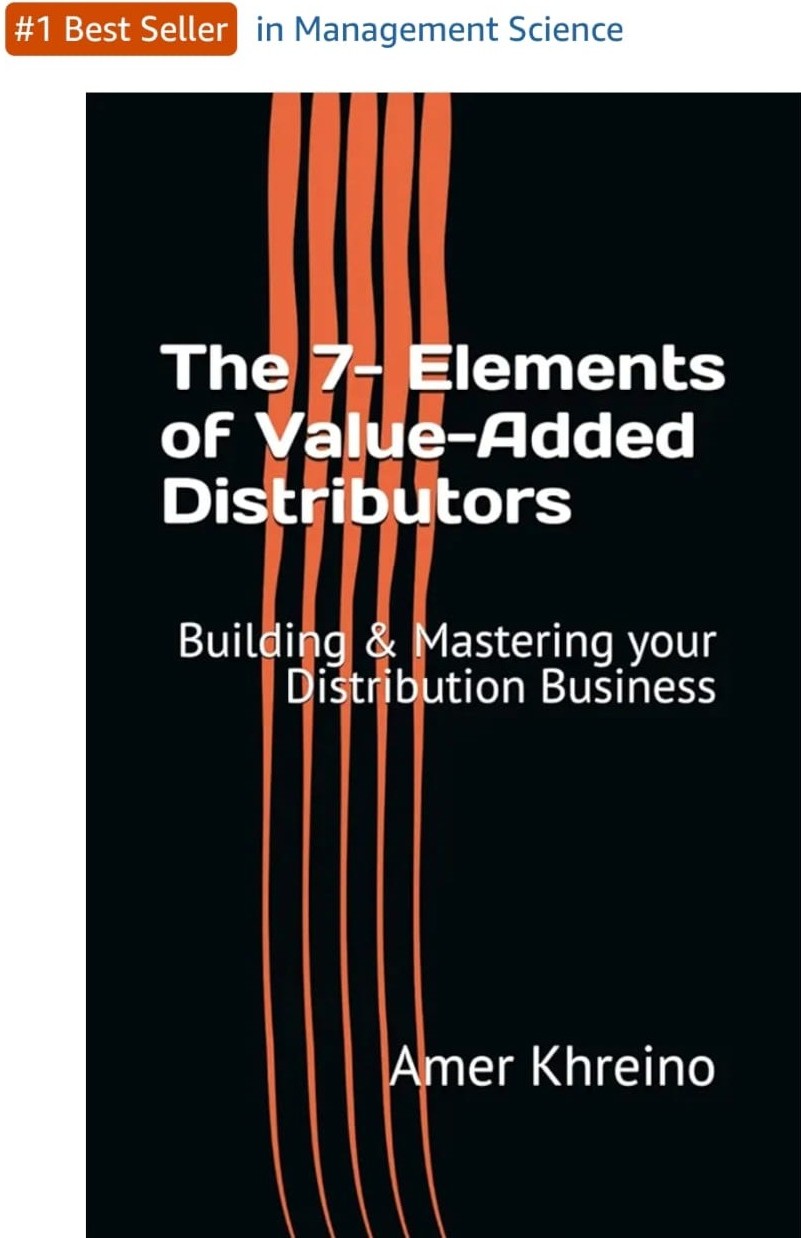
#1 Best Seller Book
Amazon
Management Science | May 2026
Q&A - Distributors in the Digital Era
Q1. How does your “7 Elements” framework help distributors move beyond margin pressure and commoditisation to achieve sustainable profitability?
A1. Traditionally, distributors have relied on financial strength and logistical efficiency to help vendors bring products to market. However, this model is no longer sufficient. Increasing supply chain complexity, rapid technological innovation, evolving financing solutions, and more sophisticated product portfolios have fundamentally changed the landscape.
The 7 Elements of Value-Added Distributors© framework takes a 360-degree view of how modern distributors can evolve into true value-added partners by strengthening distinct success elements across their operating model.
Margin erosion typically occurs when differentiation—and therefore value—declines. The framework addresses this by enabling distributors to systematically move up the value chain. It provides clear guidance on optimizing financial structures to maximize returns on every dollar invested, enhancing logistics capabilities to deliver greater efficiency and service quality, and implementing the right tools and processes to ensure effective and consistent execution.
It further demonstrates how strategic vendors & product portfolio selection can expand market reach while improving margins, and how building economies of scale can sustainably enhance profitability.
At the core of the framework are value-added services, which unlock new revenue streams and differentiation opportunities. These services enable distributors to better support their partners, improve customer outcomes, and ultimately shift from margin compression to value-driven growth.
Q2. What were the biggest gaps you observed in traditional distribution models that led you to develop this structured, field-tested approach?
A2. Traditional distribution models have struggled to keep pace with the rapid evolution of modern markets. While value-added distribution has proven to be one of the most effective go-to-market models across industries—such as Information Technology, Cyber Security, Electronics, Pharmaceuticals, Industrial materials, and Power tools—many legacy approaches remain anchored in a narrow view of success.
Historically, distribution has been driven by two core functions: financing and product movement. While still essential, these alone are no longer sufficient. Critical capabilities—such as digital marketplaces, advanced funding solutions, and partner-enablement services—are often underdeveloped or entirely absent in traditional models.
What I consistently observed was a structural gap between how distributors operate and what the modern ecosystem demands.
The “7 Elements” framework addresses this gap by incorporating today’s technological and business innovations into a cohesive operating model. It highlights how distributors can lead and differentiate in the market through capabilities such as supply chain finance and Device-as-a-Service (DaaS) models, robotics-enabled logistics enhanced by RFID and IoT for greater speed and accuracy, AI-driven systems for improved customer experience and governance, cloud marketplaces to expand reach, and advanced demo and solution centers to showcase and validate solutions through proof of concept.
In essence, the framework shifts distribution from a transactional model to a capability-driven, innovation-led platform.
Q3. How does the MAAP™ platform translate your framework into a measurable, data-driven transformation for distributors?
A3. The MAAP™ platform—our 360-degree Health Check, Maturity Assessment, and Audit Platform—is purpose-built for distribution businesses across major industries. It is calibrated for sectors such as IT broadline, cybersecurity & AI value distribution, industrial distribution, pharmaceuticals, and FMCG.
While the core model is anchored in the “7 Elements” framework, the platform incorporates industry-specific dynamics, including margin structures, operating models, and competitive benchmarks, directly into its assessment logic.
MAAP™ goes beyond a traditional diagnostic tool. It evaluates current maturity across all critical capabilities, identifies performance gaps against best-in-class benchmarks, and quantifies the impact across key metrics such as margin improvement, revenue growth, and operational efficiency.
Most importantly, it translates these insights into prioritized, actionable recommendations—enabling leadership teams to align strategy, operations, and investment decisions with measurable outcomes.
Q4. In what ways can distributors effectively capitalise on emerging technologies like AI, IoT, and cloud to create real value rather than added complexity?
A4. Emerging technologies such as AI, IoT, and cloud are powerful—but only when applied with clear business intent. The real challenge for distributors is not adoption, but disciplined integration.
At its core, distribution remains a fundamentals-driven business. Growth still depends on how effectively you manage operations, serve customers, and scale value. These technologies are not a departure from that—they are enablers that enhance how those fundamentals are executed.
For example, robotics and IoT are transforming warehouse management and inbound/outbound operations by improving speed, accuracy, and cost efficiency. AI is elevating CRM and ERP systems, enabling faster response times, better customer insights, and stronger risk management. Meanwhile, cloud platforms are creating digital marketplaces that streamline engagement between vendors, partners, and customers—from product discovery and service delivery to payments, tracking, and renewals.
The key is to adopt these technologies with a clear link to measurable outcomes—whether improving margin, enhancing customer experience, or increasing operational efficiency. Without that alignment, technology risks adding complexity rather than value.
Q5. With distribution becoming increasingly global and complex, what strategic mindset shifts are essential for leaders to remain competitive in the digital era?
A5. To remain competitive in an increasingly global and complex environment, distribution leaders must shift from managing operations to continuously building differentiated capabilities.
This starts with a mindset focused on creating sustained customer value—by embracing impactful technologies that reduce cost, enhance efficiency, and elevate the customer experience. At the same time, leaders must remain agile, adapting their business models as market dynamics evolve.
What distinguishes the “7- Elements of Value-Added Distributors” framework is its ability to provide both structure and flexibility. It defines all the critical success elements required in modern distribution, while allowing each element to be weighted differently based on industry dynamics and strategic priorities.
For example, inventory efficiency plays a very different role depending on the sector. Days Inventory Outstanding (DIO) might average around 25 days for an IT broadline distributor, while 90 days could be typical in industrial distribution. Similarly, a cybersecurity value distributor may place greater emphasis on channel enablement, whereas an IT broadliner may prioritize configuration and staging services.
This adaptability ensures that leaders are not applying a one-size-fits-all model, but rather a dynamic framework that evolves with their business—enabling them to stay competitive, relevant, and resilient in the digital era.
Amer Khreino
Founder
Business Executive and Management Advisor
25+ years of international business experience providing strategic, fiscal, and operational leadership to global enterprises as CEO, Board Director, and Advisor.
Author & Designer of THE 7- ELEMENTS OF VALUE-ADDED DISTRIBUTORS© | Building & Mastering your Distribution Business.